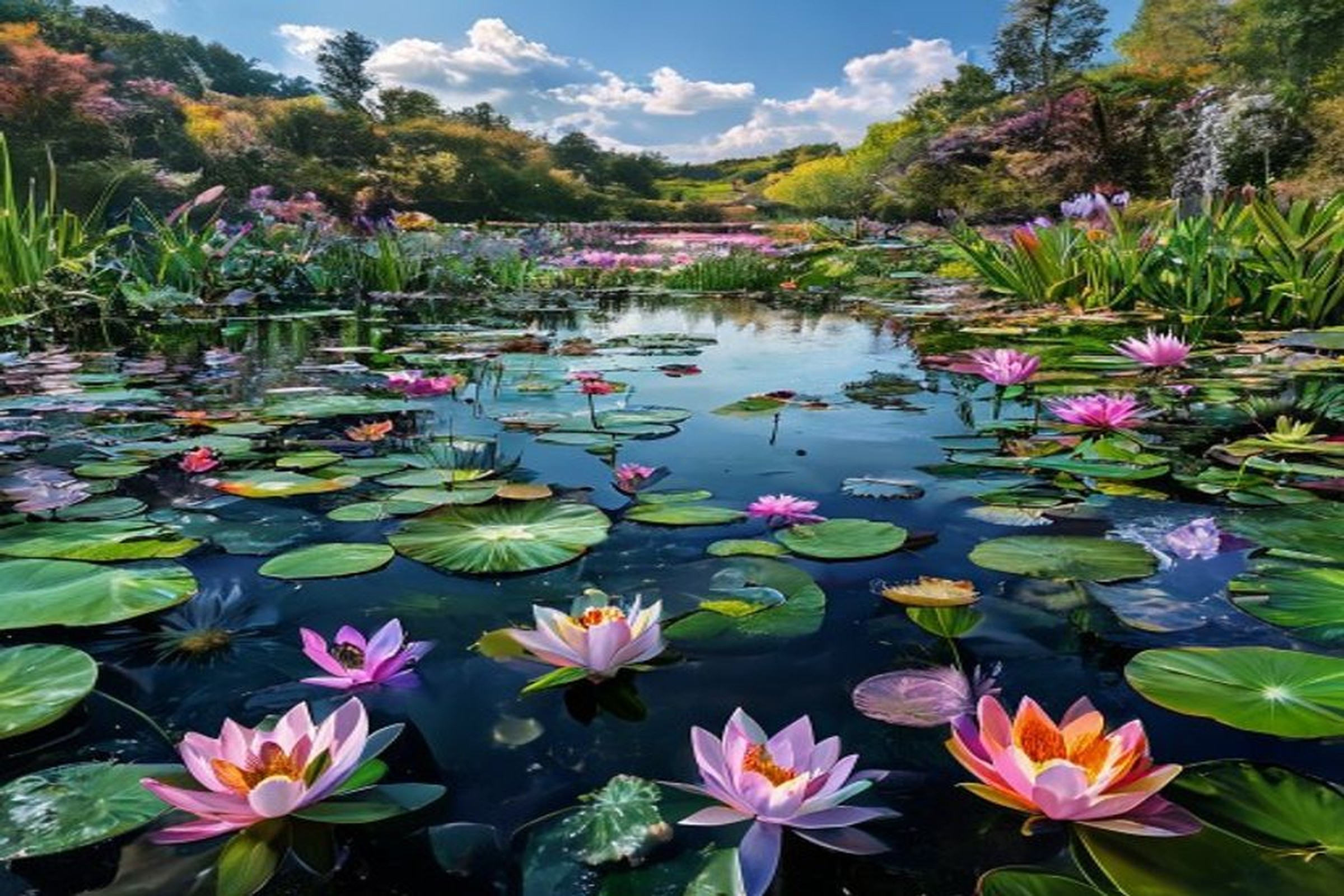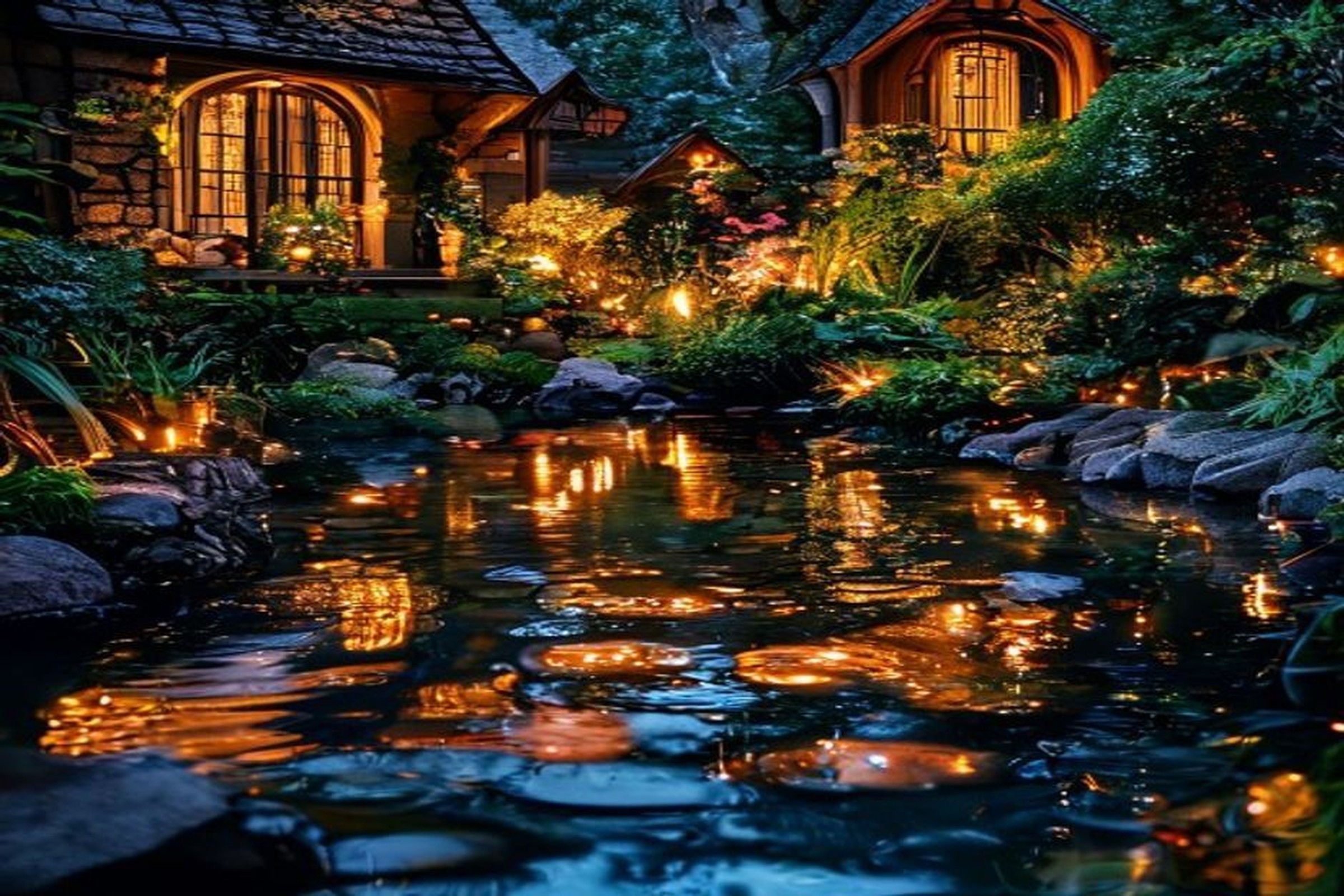
A natural pond is a garden jewel - but once the sun sets, its beauty disappears into darkness. Proper lighting completely transforms the experience: water gains depth and mystery, surrounding plants become living sculptures, and waterfalls seem to dance in the light. More than a simple decorative element, pond lighting extends the hours you can enjoy your outdoor space, adds safety, and significantly increases property value. In this comprehensive guide, the Iazuri Naturale team shows you step by step how to plan and implement a lighting system that highlights everything beautiful about your pond.
Why does pond lighting matter?
Many homeowners invest considerable sums in pond construction, aquatic plants, and filtration equipment, but neglect lighting. It's a missed opportunity, and here's why:
- Atmosphere and ambiance - An illuminated pond becomes the focal point of the garden on summer evenings. Light reflected on the water surface creates a relaxing atmosphere, perfect for romantic dinners, gatherings with friends, or moments of personal tranquillity.
- Safety - An unlit pond poses a real danger at night, especially if you have children or pets. Perimeter and underwater lighting clearly marks the boundaries of the water surface and deep areas.
- Property value - Real estate studies show that a well-lit landscape can increase a property's value by 15-20%. A pond with professional lighting is a luxury feature that attracts the attention of potential buyers.
- The joy of enjoying your pond in the evening - Without light, your pond is invisible for roughly 10-14 hours per day (depending on the season). With a well-designed lighting system, these hours become the most magical moments of the day.
- Observing aquatic life - Koi fish and other species become spectacular under underwater light. You can observe their nocturnal behaviour and enjoy their vibrant colours even after sunset.
Lighting doesn't just mean "putting some bulbs near the water." It's an art that combines technique with aesthetics, and the results can be truly spectacular when properly planned.
Underwater lighting: the magic beneath the surface
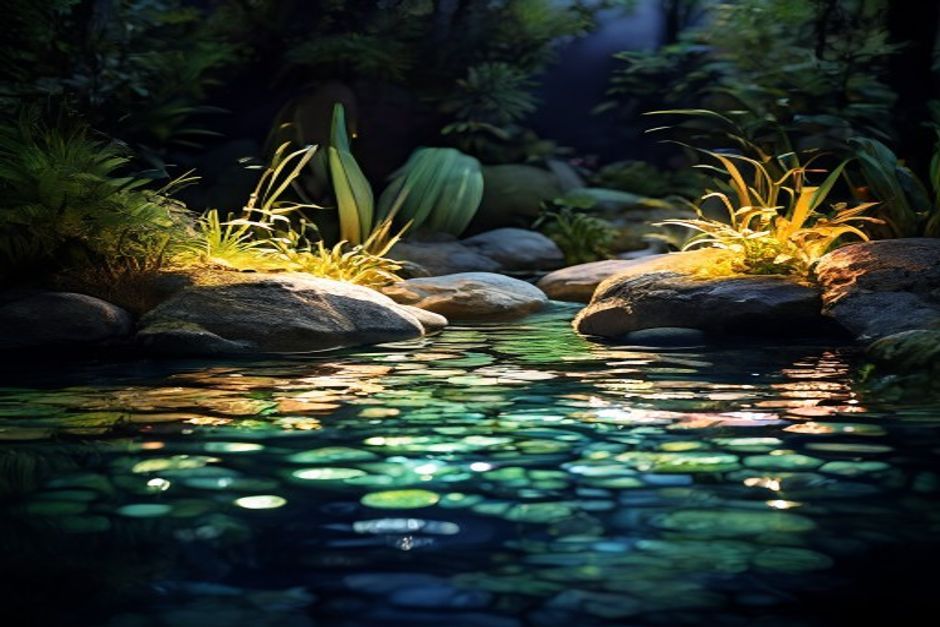
Underwater lighting is, without a doubt, the most impressive form of pond illumination. Submersible LED spotlights transform the water into a luminous medium, creating effects that no other form of lighting can reproduce.
Types of underwater light fixtures
The most popular options are submersible LED spotlights, available in power ratings from 3W to 36W. For a medium-sized pond (15-30 m²), 6-10W spotlights offer an excellent balance between intensity and consumption. Underwater light fixtures must be IP68 certified, which guarantees complete protection for continuous immersion.
Where to place underwater spotlights
- On the pond floor - Upward-facing spotlights create a dramatic effect, illuminating the entire water column. Place them at least 30 cm from the pond edge to avoid shining directly into the eyes of nearby people.
- On the interior walls - Mounted on the pond walls at a depth of 20-40 cm below the water level, spotlights highlight the texture of rocks and submerged plants.
- Under water lilies and floating plants - A spotlight placed under a cluster of water lilies creates an absolutely fascinating filtered light effect.
- In the fish zone - If you have Koi or other ornamental fish, a warm light spotlight placed in their preferred resting area will showcase them spectacularly.
Practical rules for underwater lighting
As a general rule, use 1 submersible spotlight for every 3-5 m² of water surface. Don't overdo the number of sources - an overly lit pond looks artificial. The goal is to create focal points and contrast zones, not to flood everything with light. Aim spotlights at elements you want to highlight: an interesting rock formation, a group of plants, the waterfall zone.
Perimeter lighting
If underwater lighting creates the magic inside the pond, perimeter lighting defines the context and ensures a harmonious transition between the pond and the rest of the garden. It's also the essential component for safety.
Light fixtures for paths around the pond
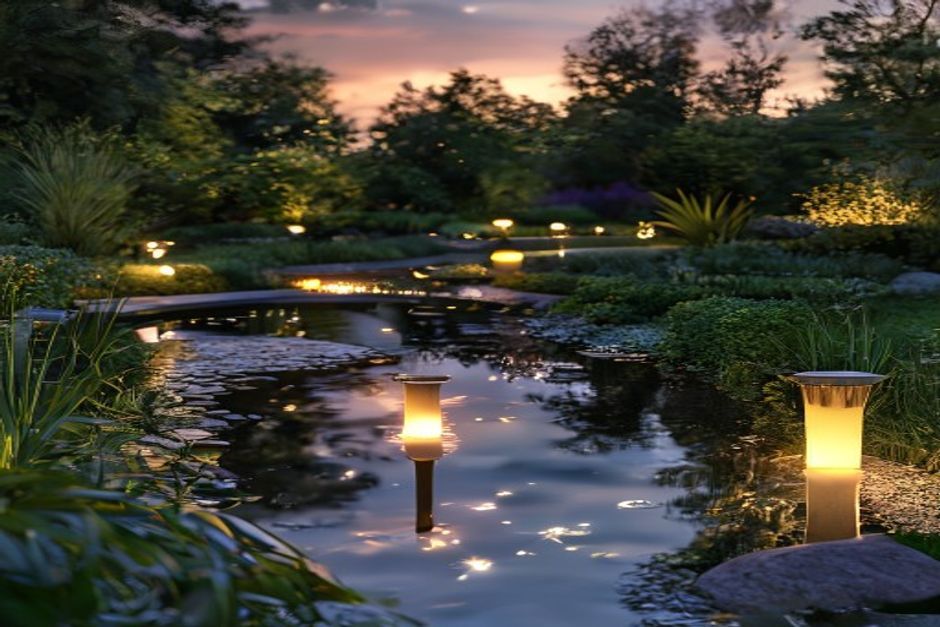
Path lights with heights of 30-60 cm are ideal for marking routes around the pond. Place them at intervals of 2-3 metres, alternating on both sides of the path for a more natural effect. Choose models with frosted diffusers that distribute light evenly without causing glare.
Light bollards
Bollards are illuminated posts with heights of 60-100 cm, suitable for areas where you need more visibility. They're excellent at entrances to paths leading to the pond and in relaxation areas along the bank.
Uplighting for plants and trees
One of the most effective landscape lighting tricks is uplighting - placing a spotlight at the base of a tree or shrub, aimed upward. This effect creates dramatic silhouettes and adds verticality to the night scene. For mature trees around the pond, use 10-15W spotlights at a distance of 30-50 cm from the trunk. For shrubs and ornamental grasses, 3-5W spotlights are sufficient.
An important detail: perimeter lighting should be more subtle than underwater lighting. Its role is to complement, not compete with the effects in the water.
Iazuri Naturale designs and installs custom filtration systems for any type of pond.
View our services →Spotlights for waterfalls and water features
If your pond includes a waterfall or artificial stream, you have one of the most spectacular lighting opportunities at your disposal. Moving water captures and redistributes light in fascinating ways, creating dynamic effects that never tire the eye.
Waterfall lighting
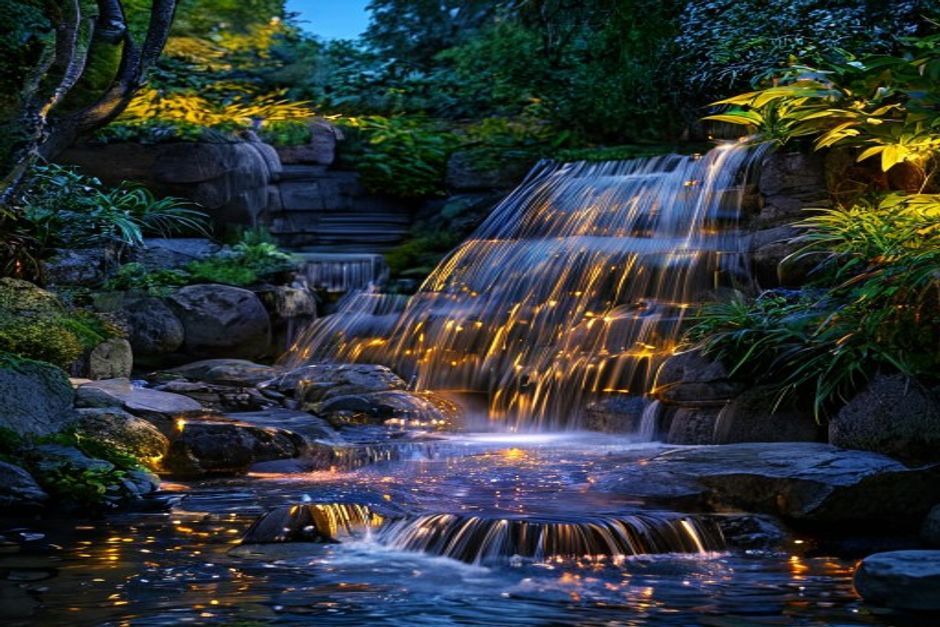
The secret is to place the spotlight behind or beneath the water jet, not in front of it. Light passing through the curtain of water creates a spectacular translucent effect. Use 6-10W spotlights with a narrow beam (15-30°) for waterfalls up to 1 metre wide. For wider waterfalls, add an additional spotlight every 60-80 cm.
Stream lighting
For an artificial stream, place small spotlights (3-5W) at irregular intervals along the course. Don't illuminate every segment - leave shadow zones for contrast. Position spotlights below the water level, aimed in the direction of the current. Water flowing over a submersible spotlight creates reflections and light play on the bankside vegetation.
Additional effects
An advanced technique is illuminating the rocks over which water flows, rather than the water itself. Light reflected off the wet stone surface creates a natural sheen that suggests movement without being visually aggressive. Combining multiple light sources with different intensities adds depth and drama.
LED vs. halogen: choosing light sources
Until a few years ago, halogen lamps were the standard in landscape lighting. Today, LED technology has taken over, and rightfully so. However, it's worth understanding the differences to make the right choice.
LED advantages
- Energy efficiency - A 6W LED produces the same amount of light as a 35W halogen. The saving on energy bills is 80-85%.
- Durability - A quality LED has a lifespan of approximately 50,000 hours. At 8 hours of daily use, that's over 17 years. A halogen lasts an average of 2,000-3,000 hours.
- Low heat output - LEDs produce very little heat, which is essential in an aquatic environment. Halogen can locally heat the water, affecting plants and fish.
- Colour options - LEDs are available in warm white (2700K), neutral white (4000K), cool white (6000K), and RGB variants with millions of colours.
- Compact dimensions - LED fixtures are significantly smaller, allowing discreet integration into the pond.
When does halogen still make sense?
The only situation where halogen may be preferred is when you're seeking a warm light with perfect colour rendering (CRI 100) for a very specific area. Halogen light has a distinctive quality that's hard to reproduce exactly with cheap LEDs. That said, modern premium LEDs achieve CRI of 95+, practically eliminating this advantage. The Iazuri Naturale team's recommendation is clear: choose LED every time.
Warm white vs. RGB: what suits your pond
One of the most frequent questions we receive is: "Should I use coloured or white lights?" The answer depends on what atmosphere you want to create and how you'll use the pond.
Warm white (2700-3000K) - the natural choice
For most natural ponds, warm white light is the ideal choice. This colour temperature mimics sunset and candlelight, creating a warm, inviting, and relaxing atmosphere. The green of plants looks natural, stones take on warm tones, and fish appear more vibrant. A warm white-lit pond looks as if illuminated by the full moon - exactly the effect you're looking for in a natural garden.
RGB - for events and accents
RGB (Red-Green-Blue) lights allow you to change colours at will. They're excellent for:
- Parties and special events
- Holidays (blue for New Year, green for Christmas)
- Temporary accents for dramatic effect
- Commercial properties and event spaces
However, a pond permanently lit in electric blue or neon green looks artificial and tires the eye. If you choose RGB, use it sparingly and keep warm white as the default setting.
"We've learned from the experience of hundreds of projects that the most successful lighting designs are the subtle ones. A natural pond should look natural at night too. Warm, well-positioned light creates more magic than a colour show. We use RGB only as an additional option, for those special evenings when the client wants something different."
- Iazuri Naturale Team
Practical tip
If the budget allows, install LED fixtures with tunable white functionality - these allow you to adjust the colour temperature between 2700K and 5000K. This way you can choose a warmer light in summer and a slightly cooler one in winter, adapting to the seasons.
Need personalized advice? Our team offers free consultation for your project.
Schedule a consultation →Safe electrical supply
Water and electricity are a combination that requires maximum caution. Electrical safety is not an area for compromises or cost-cutting. Here are the fundamental rules:
Low voltage 12V
All pond light fixtures must be powered at 12V or 24V via a safety transformer. Never use mains voltage (230V) near water. The transformer should be mounted in a sealed enclosure, at least 2 metres from the pond edge, in an area protected from flooding.
IP protection rating
For underwater fixtures, the minimum certification is IP68 (complete protection for continuous immersion under pressure). For perimeter fixtures, IP65 is sufficient (protection against water jets). Always check manufacturer specifications and don't improvise with fixtures not designed for outdoor environments.
Residual current protection (GFCI/RCD)
The electrical circuit powering the pond lighting must be protected by a 30mA residual current device. This device disconnects the circuit in milliseconds if it detects a current leak, preventing electrocution. It is mandatory under current regulations.
Cable routing
- Use outdoor-rated cable with UV and moisture-resistant sheathing.
- Bury cables at a minimum depth of 40 cm or protect them in conduit.
- Avoid underwater joints - if absolutely necessary, use IP68-certified underwater connectors.
- Mark cable routes on your garden plan for future reference.
Hire a certified electrician
This is not optional advice. Electrical installation around and inside a pond must be carried out by a certified electrician. They will correctly size the cables, select appropriate protections, and issue a verification certificate. Savings made through DIY installation can have serious consequences.
Automation and smart control
A modern lighting system is not limited to a switch that turns lights on and off. Automation brings comfort, energy savings, and creative possibilities that are worth the investment.
Timers and programmers
The simplest level of automation is a timer that turns on the lights at a set time and turns them off after a preset interval. For example, programming from 8:00 PM to 11:30 PM during the warm season. Digital timers allow different programming for each day of the week.
Dusk sensors
A more elegant solution is ambient light sensors (dusk sensors) that automatically turn on the pond lighting at sunset and off at sunrise. The major advantage is that they automatically adapt to the changing day length throughout the year, without any manual intervention.
Smart systems controlled by app
WiFi or Zigbee controllers allow complete management of the lighting from your phone. You can:
- Turn individual groups of light fixtures on and off
- Adjust the intensity of each spotlight individually
- Change the colour (for RGB fixtures)
- Create predefined "scenes" - for example, "Romantic Evening" (warm light, 40% intensity) or "Party" (animated RGB)
- Control the lighting from anywhere, even when you're not at home
- Integrate with voice assistants (Google Home, Alexa)
Motion sensors
For access areas to the pond, motion sensors provide safety lighting that activates only when someone approaches. This saves energy and adds an extra level of property security.
Lighting techniques for special effects
Beyond the basic installation of spotlights, there are advanced landscape lighting techniques that can transform a beautiful pond into a nocturnal work of art. Here are some of the most effective:
Moonlighting
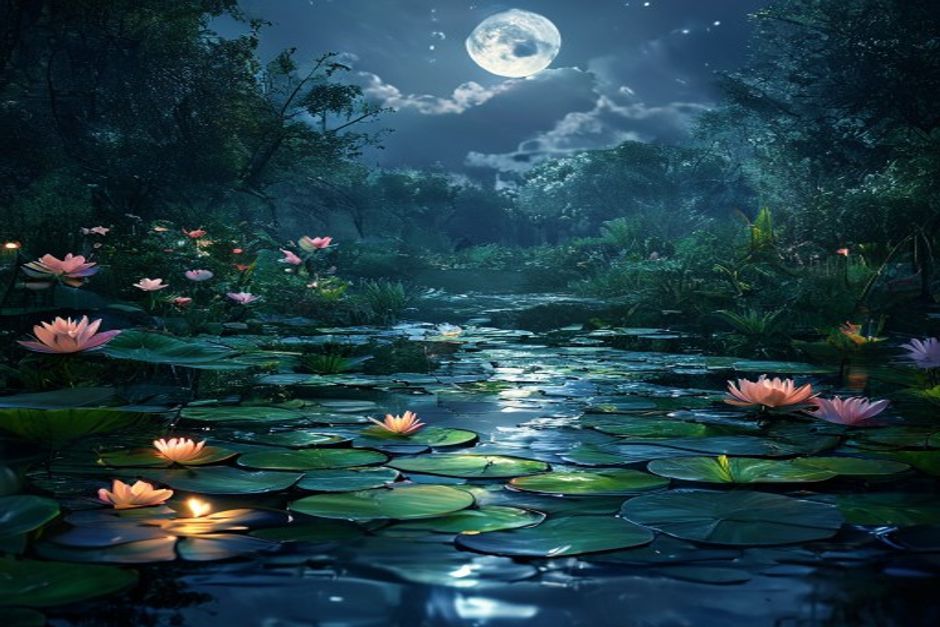
This technique involves mounting a warm light spotlight in the canopy of a mature tree, aimed downward toward the pond. Light filtered through leaves creates an effect that mimics moonlight, with natural shadows that move with the wind. It's one of the most poetic forms of landscape lighting. Use 10-15W spotlights with a wide beam (60-120°), mounted at a minimum height of 3-4 metres.
Silhouette lighting
Place a spotlight behind a plant or sculpture, aimed toward the viewer. The illuminated object becomes a dark silhouette against a bright background - a dramatic effect, ideal for tall ornamental grasses, cattails, or decorative statues on the pond bank.
Underwater uplighting on rocks
Mount a submersible spotlight at the base of a rock or group of stones inside the pond, aimed upward. The light accentuates the texture and shape of the rocks, creating strong shadows and a sense of depth. This effect is particularly impressive with natural stones that have irregular surfaces.
Floating lights
Floating luminous globes and spheres are decorative accessories that add an element of surprise and movement. Available in solar or rechargeable LED variants, they're perfect for special occasions. Place 2-3 floating spheres on a medium-sized pond for a subtle effect, without cluttering the water surface.
Grazing
Mount a spotlight very close to a textured surface (stone wall, wood, tree bark) with the beam parallel to the surface. The light "grazes" the surface, accentuating every irregularity and creating micro-dramatic shadows. This technique works excellently on natural stone walls surrounding the pond.
Mirror lighting
When you illuminate an object on the pond bank (a tree, a shrub, a sculpture), its reflection in the still water doubles the visual effect. Position the lighting so that the reflection is visible from the main viewing point - usually the terrace or relaxation area.
Planning the lighting project
A successful lighting project begins on paper, not with purchasing equipment. Careful planning makes the difference between a spectacular result and a disappointing one.
The "less is more" principle
The most common mistake is over-illumination. A pond with 20 spotlights illuminating every square centimetre looks like a supermarket car park, not an oasis of tranquillity. The golden rules:
- Directly illuminate a maximum of 30-40% of the pond surface
- Leave zones of shadow and mystery - contrast creates drama
- Focus on 3-5 main focal points
- Use different intensities to create visual hierarchy
Layering light
A professional lighting design works on three levels:
- Ambient lighting - the general, subtle light that defines the space (perimeter, moonlighting)
- Accent lighting - focused spotlights that highlight specific elements (waterfall, rock, tree)
- Decorative lighting - elements that add personality (floating spheres, lanterns, fairy lights)
Combining all three layers creates depth and visual interest, just as a professional photographer works with key light, fill light, and backlight.
Test before permanently fixing
Before cementing spotlight supports or burying cables, test the entire system temporarily. Place the light fixtures in the desired positions, connect them, and observe the effect after dark. Experiment with different angles and positions over several evenings. A 20 cm adjustment in a spotlight's position can make the difference between a mediocre effect and an impressive one.
The lighting plan on paper
Draw a sketch of the pond and surrounding garden to scale. Mark:
- The focal points you want to highlight
- Light fixture positions
- Cable routes
- Transformer position
- Main viewing points (from where you look at the pond most often)
- Areas that should remain in shadow
Realistic budgeting
A quality lighting system for a medium-sized pond (20-40 m²) involves an investment between 1,500 and 5,000 EUR, depending on complexity and the number of fixtures. Include in the budget: light fixtures (40-50% of total), transformer and cables (15-20%), electrician labour (20-25%), and a smart controller (10-15%). It's an investment that pays for itself through the years of enjoyment it brings.
The Iazuri Naturale team offers complete consultation for lighting projects, from initial planning to commissioning. In the Lighting category of our online shop, you'll find a carefully curated selection of underwater and perimeter light fixtures, tested and recommended from our project experience.
Whether you have a small garden pond or a generously sized natural lake, proper lighting can transform it into a magical space that calls you outdoors every evening. Start with a plan, choose quality equipment, follow electrical safety rules, and don't forget: the most beautiful lighting designs are those that look natural, as if the moon had paused above your garden.